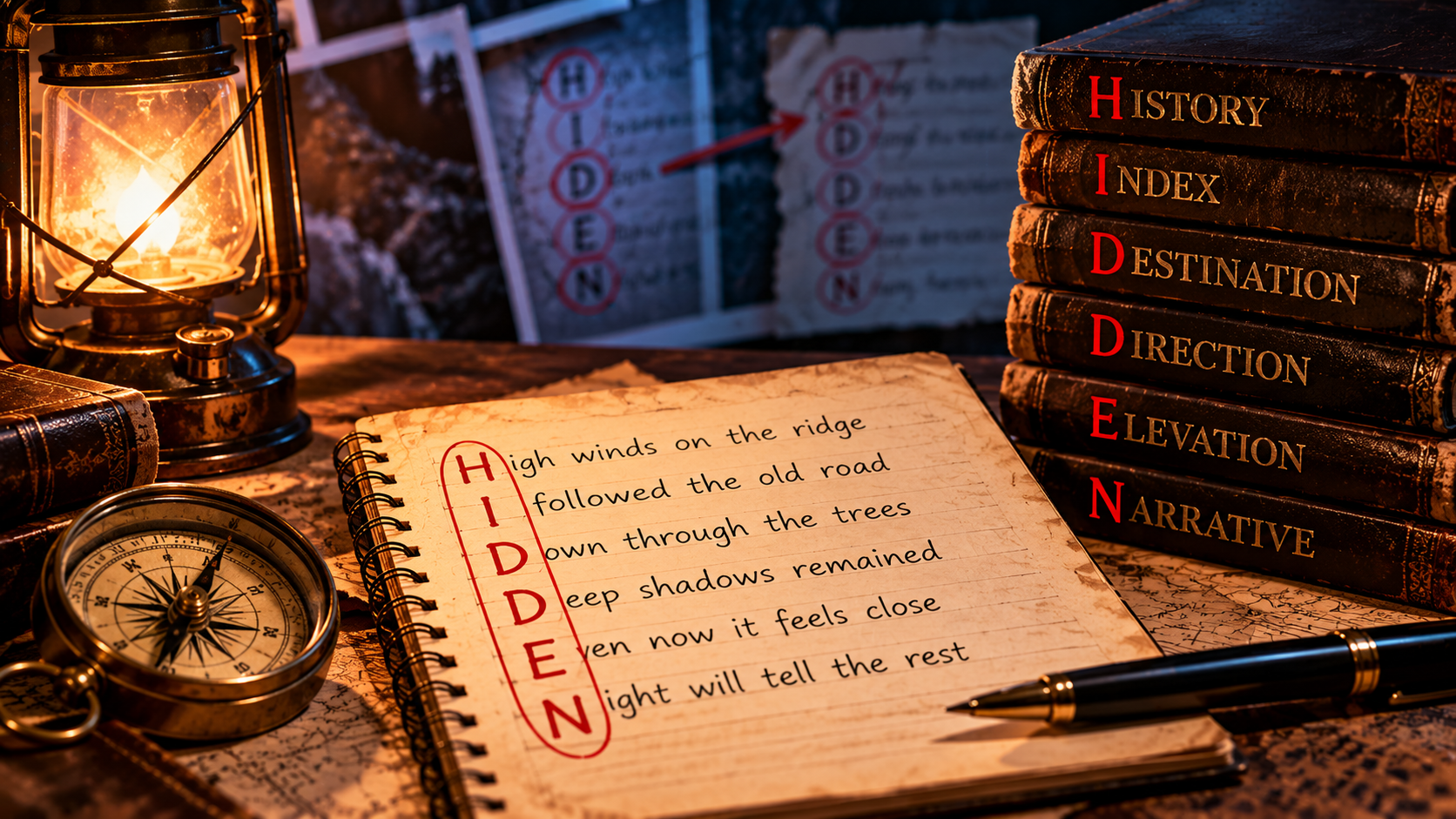
Words communicate through meaning, but letters also occupy positions. Acrostics, initials, selected letters and extraction rules let ordinary prose carry a second message.
Quick Take
Analysis
A paragraph can be completely grammatical while its first letters spell something else. That is why letter extraction is so attractive to puzzle setters: the thing carrying the hidden message can remain readable and natural.
The challenge for solvers is restraint. Given enough freedom to pick arbitrary letters, almost any text can be made to say something. A credible extraction needs a reason for choosing those particular positions.
1. Coldplay’s X&Y booklet as an explicit alphabet

Album: X&Y (2005)
The X&Y package effectively teaches the reader a substitution alphabet and then uses it across the artwork. Although this is not an acrostic, it demonstrates the core extraction principle: symbols have one visible form and a second assigned value.
Once the mapping is established, reading becomes mechanical rather than interpretive.
Clue-solving lesson: The strongest extraction rules are externally or internally constrained. You should be able to explain why those exact characters—and not convenient alternatives—were selected.
Verify this: NME — X&Y code
2. Radiohead’s OKNOTOK program message

Album: OK Computer OKNOTOK 1997 2017 (2017)
The cassette data resolves into a short computer program only after the tones are interpreted in the intended machine context. That program then displays ordinary text.
This layered path is useful for extraction puzzles: the first solve may not be the final answer. It can instead reveal the rule or key for the next layer.
Clue-solving lesson: Distinguish an intermediate instruction from a destination. A decoded word may tell you what to extract next.
Verify this: Pitchfork — OKNOTOK hidden program
3. Shakira — “Acróstico”: read down instead of across

Album: Las Mujeres Ya No Lloran (2024; “Acróstico” was originally released as a single in 2023)
Shakira's “Acróstico” provides an unusually literal demonstration of the technique. The lyrics read normally from left to right, but the beginnings of selected lines perform a second job.
In one passage, the first letters of five consecutive lines spell M-I-L-A-N. Later, another sequence of initial letters spells S-A-S-H-A. Those are the names of Shakira's two sons, to whom the song is dedicated. EL ESPECTADOR
Nothing has to be rearranged, decoded with a cipher or interpreted phonetically. The hidden information appears simply by changing the direction of your attention: instead of continuing across the lines, read down their first letters.
That makes this a particularly useful clue-solving example because the extraction rule is constrained. Once you suspect the beginnings of the lines matter, there is no freedom to cherry-pick convenient letters. Each line contributes its first letter in order.
Clue-solving lesson: When text is divided into conspicuous lines, sentences, titles or other repeated units, don't only read across them. Check the edges. First letters—and sometimes last letters—can carry a second message while the visible text continues to make perfect sense.
Verify this: La Vanguardia — the two names hidden in the lyrics of “Acróstico”
Deep Dive
Acrostic thinking should begin with conspicuous structure. Separate lines invite first/last-letter tests. Numbered items invite indexed extraction. Repeated sentence forms invite comparing the same position across sentences.
A useful hierarchy is: first letters, last letters, obvious emphasized letters, then explicitly indexed letters. More exotic extraction should require stronger prompting.
Capitalization, typography and deliberate misspellings can also serve as selectors. But the same standard applies: the feature should be anomalous enough that the extraction rule feels discovered rather than invented.
Bottom Line
Letter extraction turns surface language into a thing carrying the hidden message for positional data. The technique is simple; proving that your extraction is intended is the hard part.
Good extractions are constrained by visible structure and produce a result that explains why the structure was built that way.
Sources & References
Keep investigating
Open Question
If you had to state your extraction rule in one sentence before seeing the result, would the rule still sound natural and justified?
Community research
Community Contributions
Approved research contributions appear here after review.