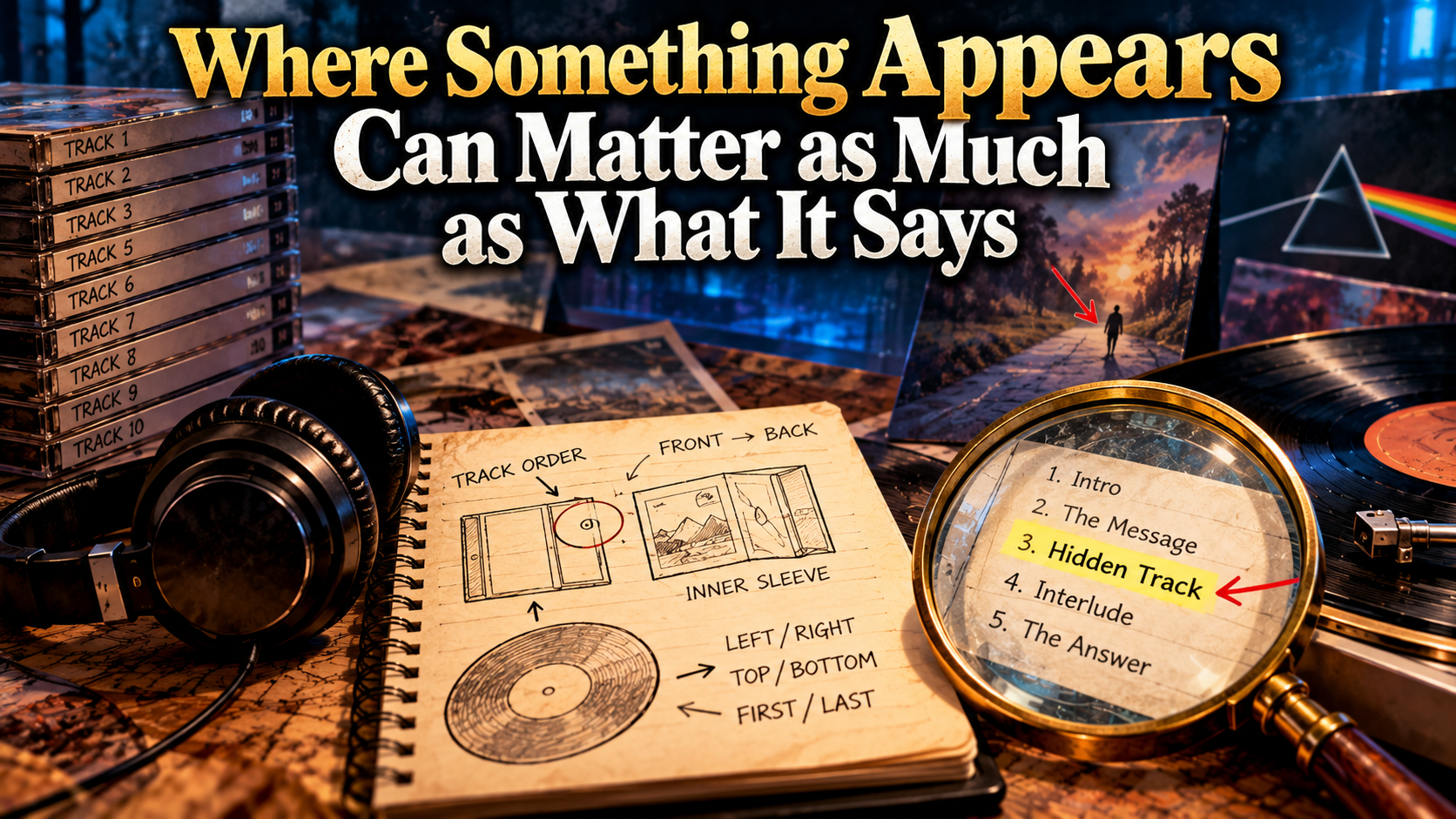
Position is information. Track number, beginning versus end, left versus right, inside versus outside and before versus after can all carry meaning independently of content.
Quick Take
Analysis
We tend to treat location as a container for information: the word matters, while its position is incidental. Puzzles often reverse that relationship.
Music albums make position easy to notice because songs have explicit order, physical media has sides and grooves, and stereo has spatial channels. Once you learn to see placement as data, the same principle transfers naturally to pages, maps and routes.
1. “Fingertips” — They Might Be Giants
Album: Apollo 18 (1992)
The twenty-one fragments of “Fingertips” were indexed so CD shuffle could redistribute them among the album’s other songs. The content of each fragment stays the same, but its relationship to neighboring tracks changes.
That makes placement part of the experience. The same fragment can feel different depending on what comes immediately before and after it.
Clue-solving lesson: When pieces seem independent, test whether adjacency or ordering creates the intended relationship.
Verify this: TMBW — “Fingertips” documentation
2. The end of OKNOTOK’s cassette — Radiohead
Album: OK Computer OKNOTOK 1997 2017 (2017)
The special-edition cassette ends with computer tones. Fans discovered that feeding the tones into a ZX Spectrum emulator produces a small program containing the band members’ names and a message.
The placement matters: the strange material sits at an edge of the release, where ordinary listening has effectively finished. Puzzle designers often exploit boundaries because readers mentally downgrade margins, endings, backs and peripheral material.
Clue-solving lesson: Inspect boundaries. The first, last, outermost, highest, lowest and edge-positioned elements are natural places to hide secondary information.
Verify this: Pitchfork — OKNOTOK cassette computer message
3. “Endless, Nameless” — Nirvana
Album: Nevermind (1991)
On releases that included it, the uncredited track follows “Something in the Way” only after a long stretch of silence. Early U.S. pressings accidentally omitted it, underscoring that the hidden-track behavior depended on the physical mastering of the album.
The listener who assumes the apparent endpoint is the true endpoint misses the additional content.
Clue-solving lesson: An apparent finish line can be part of the disguise. Test whether the clue or object continues beyond the place where convention tells you to stop.
Verify this: LiveNirvana — Nevermind release details
Deep Dive
Position clues are powerful because they require almost no alteration of the underlying material. A creator can hide emphasis by putting something first, last, between two related items, on the reverse side, beneath an image or at a geographic intersection.
For treasure hunters, positional language deserves special attention: above, below, beside, between, inside, outside, left, right, center, corner, edge, first, final, middle and behind are simultaneously ordinary descriptive words and potential operations.
The best test is relational. Instead of asking ‘What does this object mean?’ ask ‘Why is this object here rather than somewhere else?’
Bottom Line
Content tells you what an element is. Position can tell you how to use it.
Whenever an otherwise ordinary item occupies an unusually specific location, treat that placement as a possible second channel of information.
Sources & References
Keep investigating
Open Question
What changes if you stop reading the clue as a collection of objects and instead map the relationships among their positions?
Community research
Community Contributions
Approved research contributions appear here after review.