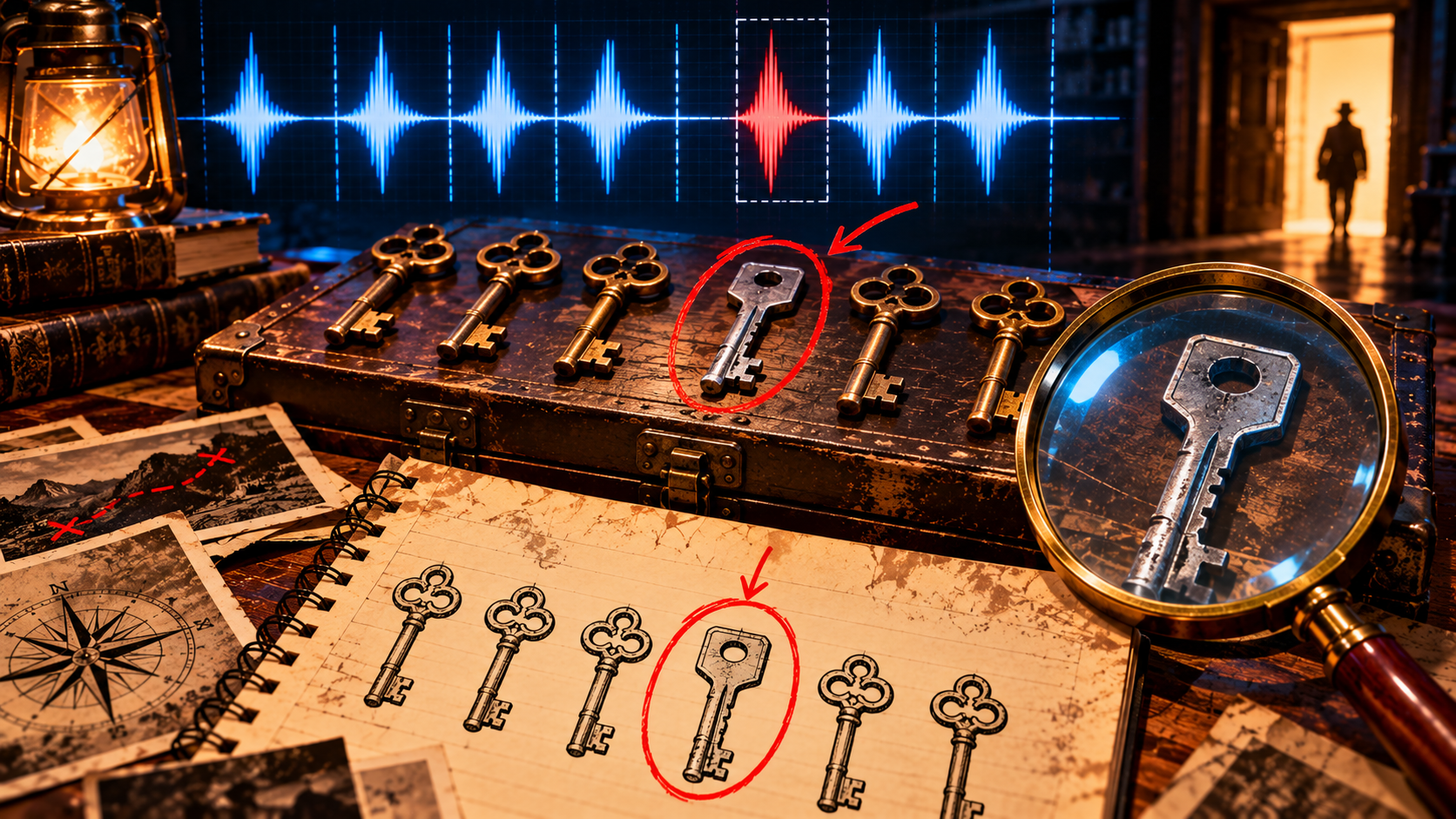
Patterns teach the solver what ‘normal’ looks like. Once a pattern is established, a deviation can become more informative than the repeated elements themselves.
Quick Take
Analysis
Music trains us to predict. A chorus returns. A beat repeats. A chord progression establishes expectations. When the pattern changes, we notice—even if we cannot immediately explain why.
Treasure clues work the same way. Repetition is not merely emphasis; it can create a baseline against which one anomaly becomes measurable.
1. “Fingertips” — They Might Be Giants

Album: Apollo 18 (1992)
The twenty-one miniature segments deliberately disrupt the normal scale of album tracks. Because conventional songs surround them, their extreme brevity is immediately conspicuous.
The contrast tells the listener that these pieces belong to a different structural role. Their indexing and shuffle behavior then explains the anomaly.
Clue-solving lesson: When one class of item behaves differently from its neighbors, investigate function before assuming error.
Verify this: TMBW — Apollo 18 structure
2. “Lateralus” — Tool

Album: Lateralus (2001)
The song’s unusual numerical organization becomes noticeable because rhythm and syllable counts form repeatable relationships rather than random irregularity.
A pattern becomes persuasive when it appears across independent features. One odd count may be coincidence; coordinated counts are harder to dismiss.
Clue-solving lesson: Look for other unusual details that support the same idea. Two different features pointing to the same rule are far stronger than one isolated curiosity.
Verify this: Maynard James Keenan on the Fibonacci influence
3. The hidden-track pause on Nevermind — Nirvana

Album: Nevermind (1991)
A normal album ends when the final listed song ends. A long silence followed by unlisted music violates that expectation.
The surprise works only because the listener already knows the normal pattern. The deviation is the signal.
Clue-solving lesson: Define normal before interpreting abnormal. Without a baseline, ‘odd’ is only a feeling.
Verify this: LiveNirvana — hidden track details
Deep Dive
Pattern analysis is especially useful in long texts. Repeated phrasing, paragraph lengths, capitalization, recurring numbers, directional words or image layouts can establish a template. The question then becomes: where does the template break?
This method also protects against overfitting. Instead of searching every sentence for a secret, you compare like with like. If nineteen entries follow one rule and the twentieth violates it, the anomaly is objectively describable.
Not every anomaly is intentional. Editing mistakes exist. Production accidents exist. That is why a suspected deviation should ideally connect to another clue, produce a usable instruction or explain an otherwise puzzling design choice.
Bottom Line
Repetition is often the clue setter teaching you the rules without announcing them. The exception can then carry the payload.
Before chasing the oddity, document the pattern it violates. That turns intuition into evidence.
Sources & References
Keep investigating
Open Question
What is the most regular feature in the material—and where does that regularity break for the first time?
Community research
Community Contributions
Approved research contributions appear here after review.