The book has already taught us what a Japanese puzzle box is
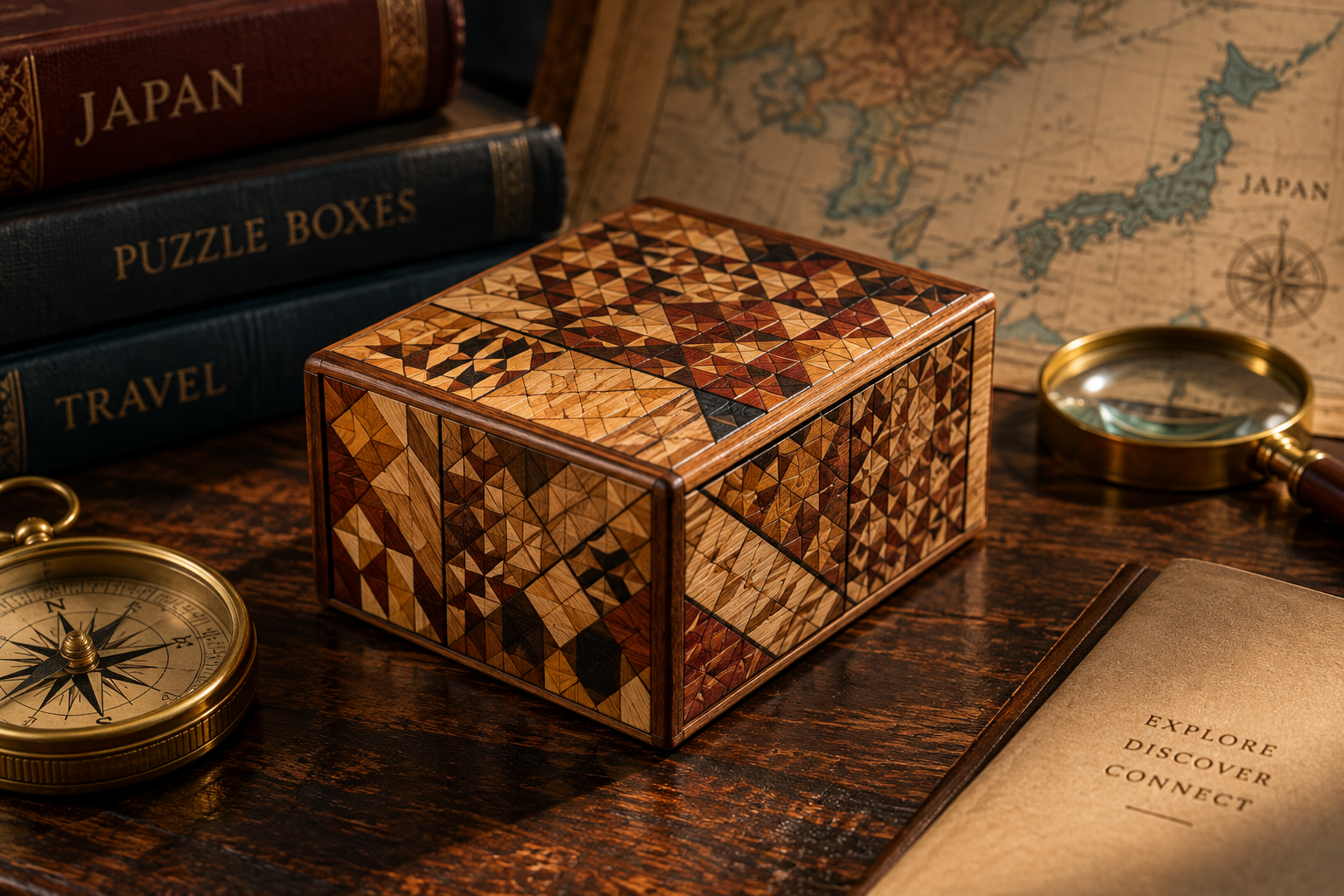
Chapter 3 describes traditional Japanese puzzle boxes in unusually mechanical terms. Their surfaces have no obvious or discernible opening; the panels must be slid to discover the way in; and each box has its own combination of movements (Chapter 3, p. 40, lines 17–24).
The emphasis is not simply on possessing the object. The pleasure comes from discovering how apparently ordinary surfaces move in relation to one another. The box conceals its solution in structure.
Chapter 25 repeats the mechanism in more precise language
When Seth Gould's Pokémon box is described, the chapter says it expresses the exact form of a traditional Japanese wooden puzzle box. It then states that a precise combination of panels must slide to open it (Chapter 25, p. 216, lines 14–23).
Jon adds that instructions explaining how to open the box have been left with it, but he still encourages the finder to experience the joy of figuring the mechanism out personally (p. 216, lines 23–25).
That is an interesting philosophy for a treasure hunt: instructions can exist without eliminating discovery. A solver can be guided toward the mechanism while still having to recognize and execute it.
The very next paragraph explains another hunt mechanism
Immediately after the puzzle-box instructions, Jon switches to the Pokémon video game. He explains that the game is a hunt, that the Pokémon characters are the treasure, and that the player must find, capture, train, evolve, and use Pokémon to assist in finding more elusive Pokémon (Chapter 25, p. 216, lines 26–31).
The adjacency is notable. First we are told how a physical puzzle box works; then we are told how a Pokémon hunt works; then Adult Jon begins the treasure-hiding adventure. Three mechanisms are placed back-to-back: open the box, play the game, follow the story.
Could the box be a metaphor for the chapter?
If the analogy is intentional, the chapter's words, images, sections, repeated phrases, and character roles may function like panels on the box. A single panel does not reveal the opening. What matters is the relationship among several pieces and the order in which they are interpreted.
This would also explain why isolated coincidences are usually weak while clusters are more persuasive. A puzzle-box mechanism requires a combination. The hunter's task may therefore be less about finding one magical sentence and more about discovering which observations move together.
Community research
Community Contributions
Approved research contributions appear here after review.