The first jazz bar opens into another world
Young Jon's New Orleans episode is written like a threshold crossing. He slips ahead of his parents, hears music, enters a bar, becomes transfixed by the musicians, and wonders what incredible world he has stepped into. Jon explicitly compares the experience to passing through Kirke's wardrobe or Alice's looking glass (Chapter 25, p. 213, lines 15–33).
That comparison matters because it gives the childhood scene a fantasy vocabulary before the chapter ever introduces Pokémon. Young Jon temporarily crosses out of ordinary family travel and into an enchanted-feeling environment, only to be escorted back outside when his parents find him.
The adult story begins at another jazz bar
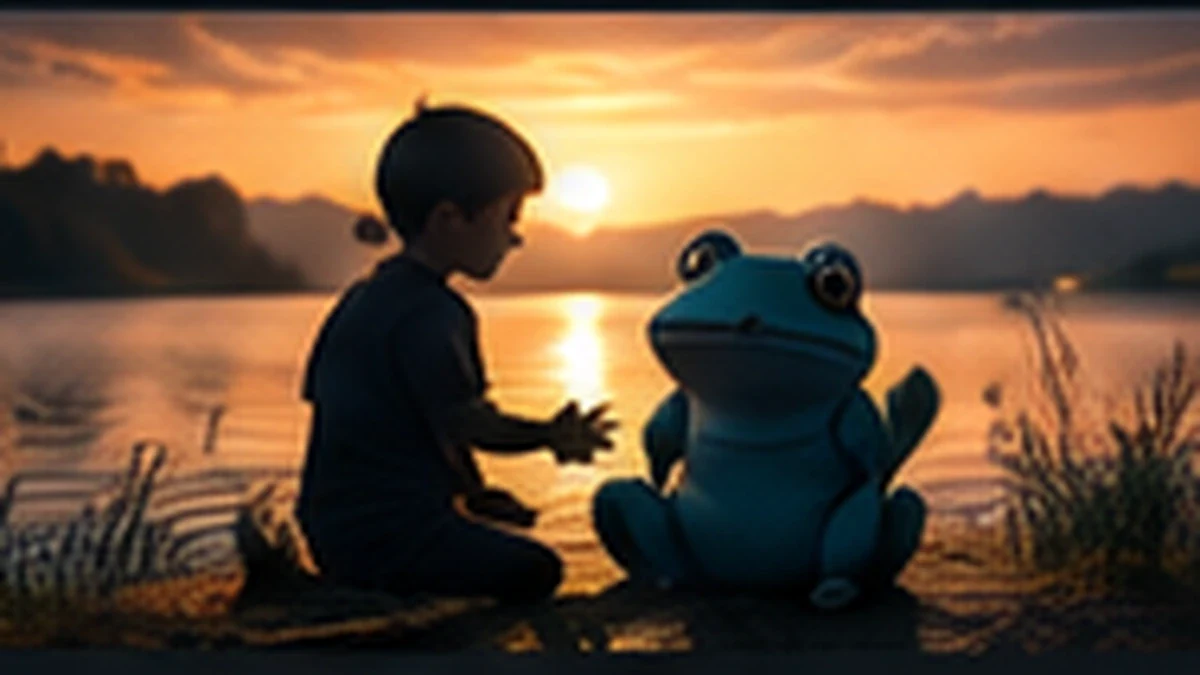
When Adult Jon later decides to hide the Pokémon treasure near somewhere connected to the old road trip, he says the task may require help. He therefore goes in search of a Pokémon who might know the area. Where does he find that helper? At a local jazz bar. The Pokémon is Froakie (Chapter 25, p. 217, lines 1–14).
The repetition is unusually specific. The childhood story's most memorable human encounter begins inside a jazz bar; the adult hiding story's central companion is introduced inside another jazz bar. If the later story is metaphorically replaying the earlier one, the matching setting looks less like decoration and more like a hinge between the two narratives.
The childhood creature hunt becomes a Pokémon hunt
After describing the jazz-bar memory, Jon broadens the childhood trip into a catalog of exploration. He turns over rocks in riverbeds and streams looking for salamanders and crawdads, hunts grasshoppers, chases fireflies, and walks among dozens of hopping toads (Chapter 25, p. 213, lines 34–44).
On the very next page, the chapter discusses people searching for Pokémon and then pivots to Satoshi Tajiri. Jon says he relates to Tajiri specifically because Tajiri's idea for Pokémon grew from collecting bugs and insects as a child (Chapter 25, p. 214, lines 7–22).
This creates a striking three-part chain: Young Jon searches for small creatures → Tajiri searches for bugs and creates Pokémon → Adult Jon searches for a Pokémon. The middle section may therefore be doing more than giving Pokémon history. It may explain how childhood creature-hunting can be transformed into Pokémon language.
Froakie is tied directly back to the childhood trip
The connection becomes explicit when Adult Jon meets Froakie. His face reminds Jon of the army of croakers encountered on the old trip (Chapter 25, p. 217, lines 6–8). Froakie is therefore not introduced as an arbitrary Pokémon. Jon immediately anchors him to a childhood animal memory.
That does not prove Froakie is Young Jon. But it gives the metaphor a textual bridge: the adult helper is visually connected to the creatures surrounding the younger version of Jon.
Community research
Community Contributions
Approved research contributions appear here after review.