In the 2004 movie National Treasure, the lantern scene arrives when the treasure hunters appear to hit a dead end in a chamber beneath Trinity Church. Ian Howe has forced Ben Gates and his family to lead him to the treasure, and Patrick Gates needs a way to get Ian out of the room. Spotting a lone lantern, Patrick invents a historical connection to Paul Revere and the Old North Church in Boston. Ian accepts the story, leaves the Gates family behind, and follows the false trail north—giving Ben the chance to keep searching where the real treasure actually is.
That makes the scene a memorable lesson in historical misdirection: a clue does not have to be nonsense to send a hunter the wrong way. The strongest false leads often borrow enough from a familiar true story to feel immediately right.
Original explanatory graphic: Confirmers / Validation.
Analysis
Patrick’s trick works because almost everything around the false clue feels legitimate. There really is an Old North Church in Boston. Paul Revere really did arrange a lantern signal there on the night of April 18, 1775. And the famous shorthand associated with the event distinguishes one lantern for the land route from two for the water route. A lone lantern sitting in an underground chamber therefore gives Ian a story he can recognize quickly enough to act on.
But the detail that matters is the one Patrick bends. The British troops actually crossed the Charles River by water, so the signal displayed from Old North that night was two lanterns, not one. Old North Church’s own history identifies Robert Newman and John Pulling Jr. as the men who displayed the two lights. Patrick takes a genuine historical framework, attaches the wrong detail to the object in front of Ian, and turns familiarity into confidence.
For a treasure hunter, that distinction is crucial. A historical reference can be real without the interpretation built around it being correct. Sometimes the wrong date, number, person, quotation, route, or object is simply an error. Sometimes an accurate historical fact is emphasized because it draws attention away from the mechanism that actually matters. And in a deliberately constructed hunt, a near-match may even be bait designed to reward verification rather than recognition.
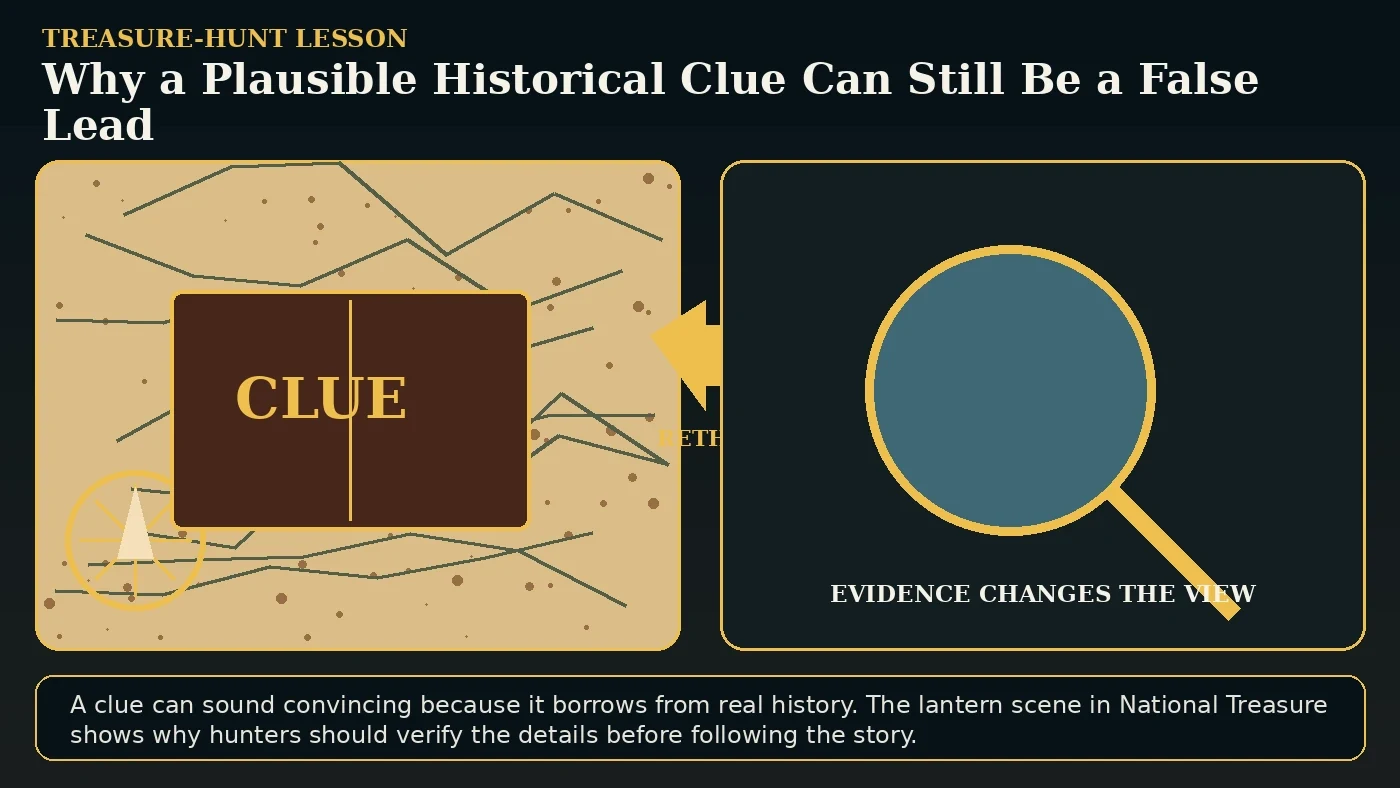
Original StaceyToon editorial illustration highlighting the central lesson of this case study.
Deep Dive
The lantern scene works because Ian stops at the first satisfying explanation. He recognizes the broad Paul Revere story, sees a physical lantern that appears to support it, and gets a destination: Boston. Those three pieces create the feeling of a solved clue. What he does not do is verify whether the details of the proposed solution agree with the historical event.
That suggests a practical test for real hunts. When a historical clue seems to click, separate the historical fact from the interpretation being proposed. Verify the date, place, people, numbers, route, and wording independently. Then ask whether the clue explains all of those details or quietly asks you to ignore one of them. In this case, checking the lantern count would immediately expose tension between the lone lantern and the actual signal used that night.
There is a second trap as well: even perfectly accurate history can become misdirection. A constructor can place a true fact where it is conspicuous precisely because hunters are likely to chase it. So verification should not end with “Is this fact true?” The stronger questions are “Why is this fact here?”, “Does it predict the next step?”, and “Does the rest of the evidence independently support that direction?”
A useful working habit is to mark historically based theories as plausible until they earn confirmation from another clue layer. Recognition starts the investigation; corroboration earns the move.
Bottom Line
A believable story is not the same thing as a verified route. Patrick Gates sends Ian to Boston by wrapping one wrong detail inside a famous piece of American history. The lesson for hunters is to enjoy the moment when a reference suddenly makes sense—but then check it. Verify the history, look for the detail that does not fit, and require independent support before allowing a compelling story to move the search.
Sources & References
Movie case study:National Treasure (2004). The scene is summarized and analyzed here rather than reproduced from the screenplay.
Historical verification: Old North Church documents that Robert Newman and John Pulling Jr. displayed two lanterns from the steeple on April 18, 1775, signaling that British troops were taking the water route across the Charles River. The church describes the system as one lantern for the land route and two for the water route.
Keep investigating
Open Question
When a clue points cleanly toward a famous historical story, what independent detail would you check before allowing that story to determine your next search location?
Approved research contributions appear here after review.
No approved community contributions yet.
Contribute to this Research
Share your strongest relevant evidence, correction, interpretation, challenge, connection, context, research lead, question, or editorial suggestion. This is for substantive research contributions rather than general conversation.
Email privacy: Your email address is private. It is not displayed publicly, used for marketing, sold, or shared at any time with anyone outside StaceyToon.com. It is used only for verification, contribution-limit/moderation controls, and necessary contribution-status communication.

Community research
Community Contributions
Approved research contributions appear here after review.