← Back

Treasure Hunting

Creator Biography as a Legitimate Puzzle Key

Key Takeaway

Creator context can constrain an authored hunt, but use documented facts and never treat biography as permission for unlimited inference.

Documented Evidence: Confirmed Observation Clue: Undetermined
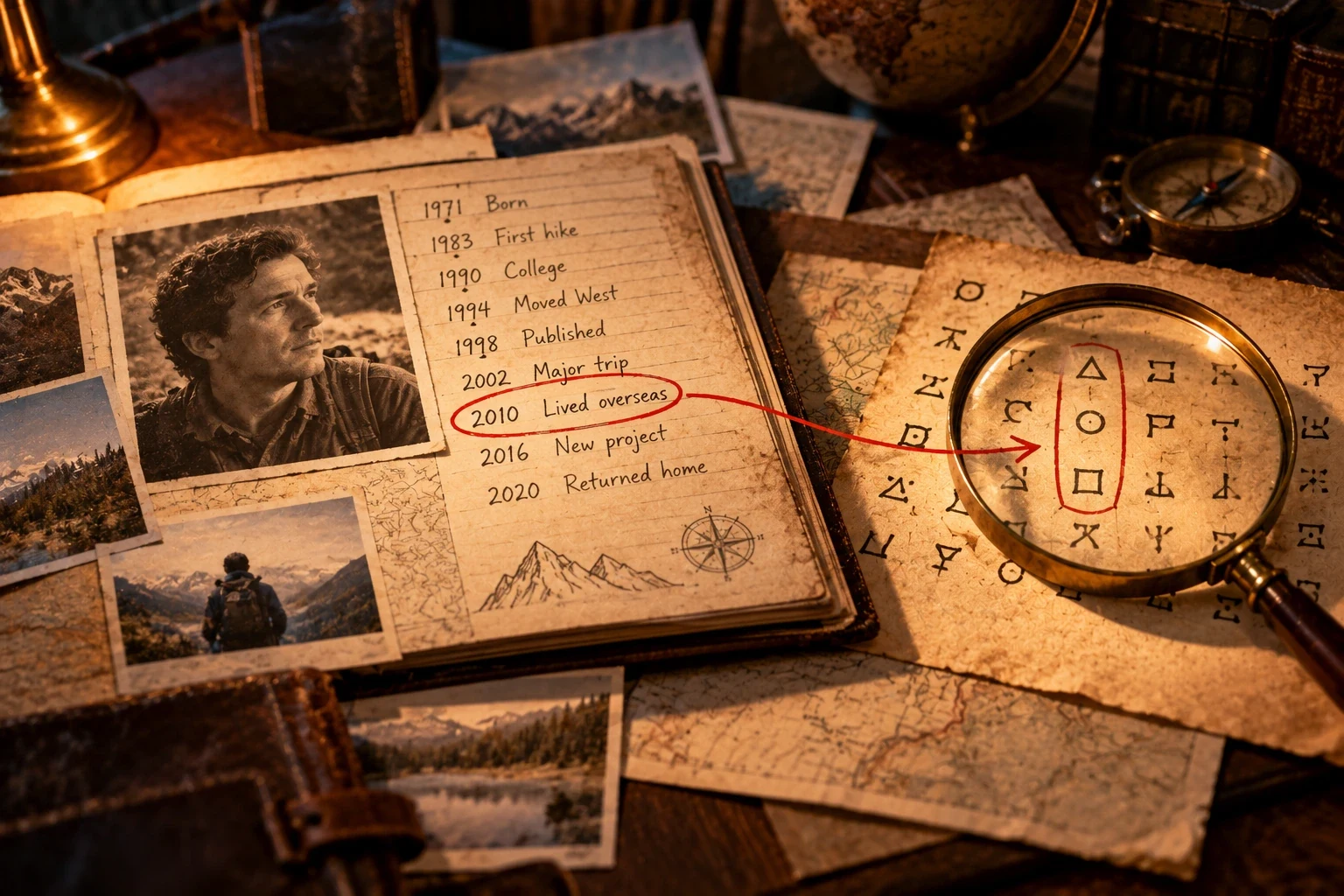
Original StaceyToon editorial illustration for Creator Biography as a Legitimate Puzzle Key
Original StaceyToon editorial illustration highlighting the central lesson of this case study.

Quick Take

In the 2018 movie Ready Player One, the story pauses on a clue that looks like part of the adventure but also demonstrates a reusable solving technique. Knowledge of Halliday’s memories, tastes, regrets, and cultural references provides context for challenges that cannot be solved from surface mechanics alone.

Seen as a movie scene, the moment is easy to remember because the characters have to turn an object, phrase, place, or historical detail into a decision. For a treasure hunter, the useful question is not simply “What did the characters find?” but what operation made the clue move forward, and what evidence told them they were using it correctly?
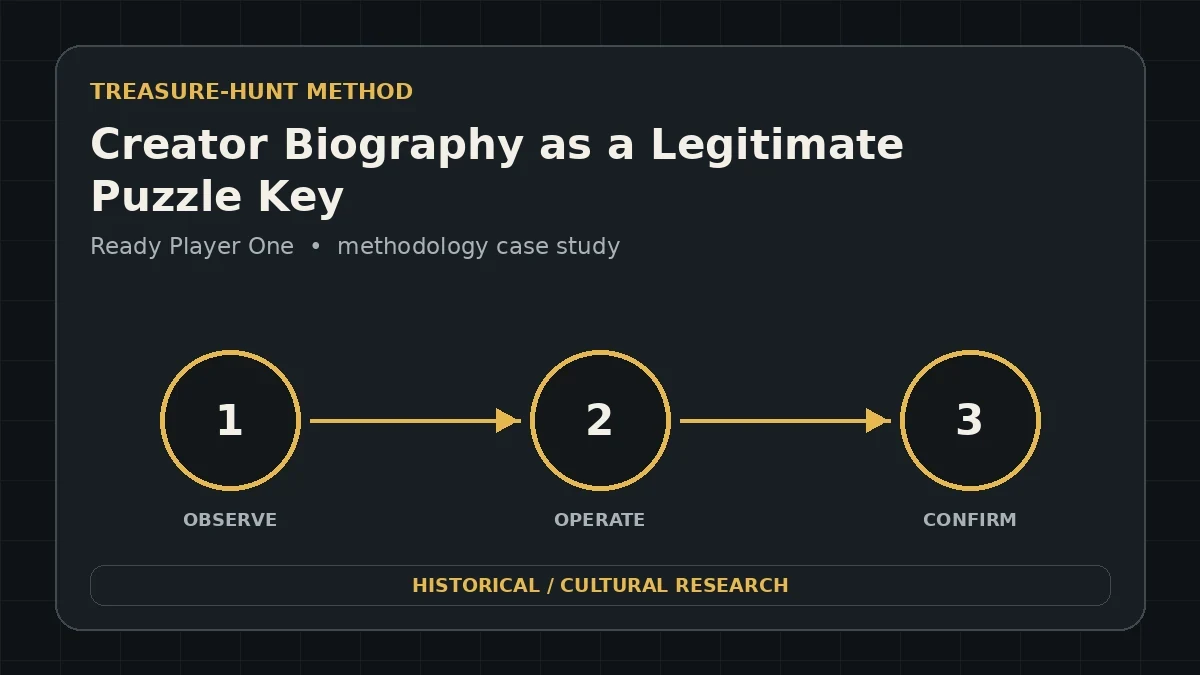
Original StaceyToon methodology diagram for Creator Biography as a Legitimate Puzzle Key
Original explanatory graphic: Historical / Cultural Research.

Analysis

How the clue works: Once the scene is set, the mechanics become easier to see. The characters do not advance because the clue merely looks mysterious; they advance because they test a specific relationship suggested by the evidence.

Knowledge of Halliday’s memories, tastes, regrets, and cultural references provides context for challenges that cannot be solved from surface mechanics alone.

For a real hunt, reproduce the logic in a controlled order. First record the observation without interpretation. Next list the small number of operations genuinely suggested by the clue. Then test those operations against the surrounding material. A successful interpretation should reduce ambiguity and produce a next step that can be checked independently.

Primary methodology: Historical / Cultural Research. Useful cross-checks: Meta-Puzzle / Synthesis, Confirmers / Validation.

Original StaceyToon editorial illustration for Creator Biography as a Legitimate Puzzle Key
Original StaceyToon editorial illustration highlighting the central lesson of this case study.

Deep Dive

The transferable point is constraint before creativity. In authored hunts, documented creator context can constrain interpretation—but use verifiable material and avoid turning biography into unlimited free association.

That means resisting two common failure modes: forcing a favorite technique onto every unusual detail, and accepting a clever result merely because it is possible. Prefer an operation that is signaled by the object, wording, historical context, geometry, or sequence itself. Then ask whether the result explains more evidence than it consumes.

When adapting this method to another hunt, keep an audit trail: what was observed, what operation was attempted, what result was produced, and what independent fact confirmed or contradicted it. That makes the solve reproducible for another hunter.

Bottom Line

Use this method when the clue itself supplies a reason to try it. In authored hunts, documented creator context can constrain interpretation—but use verifiable material and avoid turning biography into unlimited free association. The strongest application is one that produces a specific, testable next step rather than another layer of speculation.

Sources & References

Primary case study: Ready Player One (2018), feature film. This article paraphrases the puzzle mechanism for methodology education and does not reproduce screenplay dialogue, film frames, or production artwork.

Research note: Scene details should be checked against the film and reputable plot/reference sources before any later publication edit that adds quotations or more granular production claims.

Keep investigating

Open Question

What independent evidence would you require before using historical / cultural research on a real hunt clue that only partially resembles this example?

Community research

Community Contributions

Approved research contributions appear here after review.

No approved community contributions yet.

Contribute to this Research

Share your strongest relevant evidence, correction, interpretation, challenge, connection, context, research lead, question, or editorial suggestion. This is for substantive research contributions rather than general conversation.

Email privacy: Your email address is private. It is not displayed publicly, used for marketing, sold, or shared at any time with anyone outside StaceyToon.com. It is used only for verification, contribution-limit/moderation controls, and necessary contribution-status communication.

0 / 1,000 characters
Community Contribution Guidelines

Keep the contribution relevant, respectful, self-contained, and no more than 1,000 characters including spaces and punctuation. Plain text only. Do not include links, URLs, disguised links, attachments, embeds, HTML, or Markdown. If a source matters, identify it in plain language by publication, title, author, date, or useful search terms. Constructive disagreement is welcome. Do not split one contribution into multiple submissions to evade the limit.

One verified contribution per email address per article is allowed in each rolling 24-hour period. All verified contributions are reviewed, but submission does not guarantee publication or a personal response. Published contributions may be classified and ranked based on research value.

Nothing is published without Stacey's approval.
Worth sharing or saving?