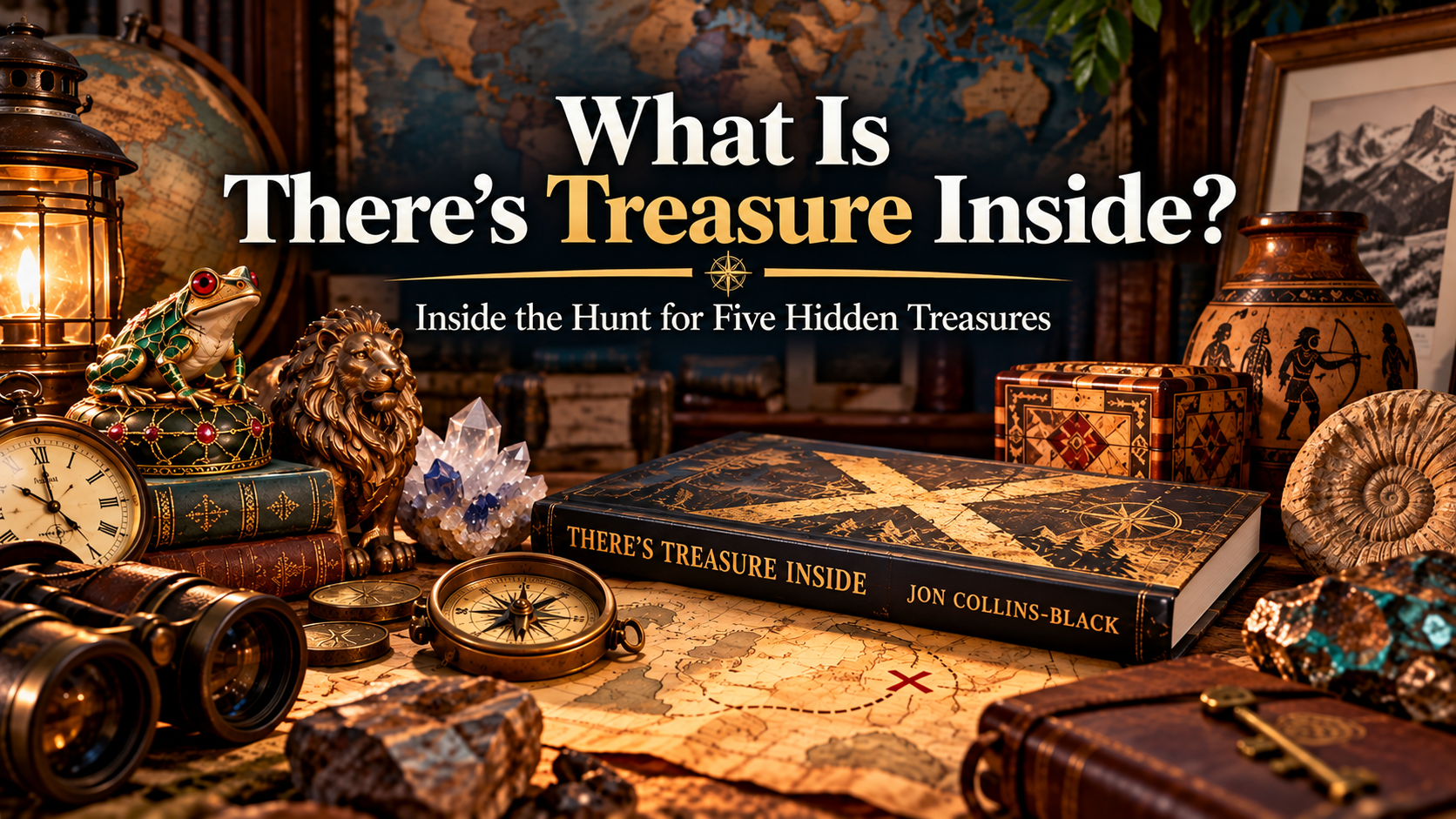
Some books tell stories about treasure hunts. There’s Treasure Inside is the treasure hunt.
Created by Jon Collins-Black and released in 2024, the book contains the clues needed to locate five real treasure boxes hidden across the United States. Together, their contents are worth millions of dollars. The prizes include rare collectibles, precious metals and gems, historical objects, cryptocurrency, Pokémon cards, and pieces connected to famous people and earlier treasure hunts.
That premise has attracted an active community of hunters who do far more than simply read the book. They compare wording, research history, study maps, test ciphers, analyze illustrations, search interviews, debate theories, and eventually put boots on the ground to see whether a solution survives contact with the real world.
One Book, Five Treasure Hunts
The hardcover is both a collection of stories and a puzzle environment. Collins-Black writes about treasures, experiences, history, collecting, and the lessons he has taken from them, while clues are embedded within the material for hunters to discover.
The hunt is unusual because it is really five hunts operating inside the same project. Four smaller treasures are associated with dedicated sections of the book. The fifth—the Lion’s Share—is the largest prize, and its clues can draw from the book much more broadly.
The boxes themselves are part of the treasure. Metalsmith Seth Gould created elaborate metal puzzle boxes for the hunt. The hidden boxes were protected for their time outdoors, but the crafted puzzle boxes shown in the book are not merely ordinary containers.
The Five Treasure Boxes
The Lion’s Share
The largest treasure in the hunt. The Lion’s Share contains the greatest share of the collection and has been described as worth more than $1 million. Unlike the four smaller hunts, hunters cannot simply isolate one dedicated treasure chapter and assume the job is contained there. The book as a whole matters, making this the broadest and potentially most complex of the five searches.
The Forrest Fenn Box
A treasure hunt born from another legendary treasure hunt. Forrest Fenn famously hid a bronze chest in the Rocky Mountains and published a poem containing clues to its location. Collins-Black participated in that hunt and later acquired objects from Fenn’s recovered treasure at auction. His Forrest Fenn Box brings some of that history into a new search, including Fenn-related treasure and the famous sealed olive jar containing Fenn’s autobiography.
The Appalachian Footpath Box
A hunt built around the outdoors and the idea of the trail. This box is associated with the Appalachian Footpath chapter and its map and narrative. It naturally appeals to hunters who enjoy geography, hiking, maps, and turning written clues into a real route through the landscape.
The Pokémon Box
Pop culture, childhood memories, and a six-figure treasure. The Pokémon Box chapter tells a playful story inspired by a childhood trip and later experiences with Pokémon. The treasure includes at least one rare and valuable Pokémon card. For hunters, the challenge is deciding which details are storytelling, which are clues, and how the pieces point toward one physical location.
The Past and Future Box
A puzzle-heavy hunt influenced by Ready Player One. Its treasure includes at least one physical Bitcoin carrying the keys to digital Bitcoin. The chapter leans openly into games and puzzles, making it particularly attractive to hunters who enjoy cryptography, extraction, pattern recognition, and layered puzzle solving.
What Is Actually Inside the Treasure?
The collection is one reason the hunt immediately stood apart. Collins-Black assembled objects intended to appeal to very different kinds of people rather than filling five boxes with identical piles of gold.
Across the hunt, the advertised treasures include Bitcoin, antiquities, shipwreck treasure, rare Pokémon cards, sports memorabilia, gold, precious metals, rare gems, and historically significant objects. Published descriptions connect items in the collection with figures including Pablo Picasso, Andrew Carnegie, George Washington, Amelia Earhart, Jacqueline Kennedy Onassis, Henry David Thoreau, and Louis Comfort Tiffany.
Not every object has been publicly assigned to a particular box. That uncertainty is part of the experience: hunters know a great deal about the overall collection while still having discoveries waiting inside the containers themselves.
Why Has the Hunt Attracted So Many People?
The money matters. A life-changing prize is a powerful reason to open a book and start looking for clues. But money alone does not explain why people spend months comparing sentences, building spreadsheets, checking maps, listening to interviews, writing code, traveling across the country, and talking with other hunters late into the night.
There’s Treasure Inside sits at the intersection of several hobbies. It is part puzzle hunt, part historical research project, part outdoor adventure, part collecting story, and part enormous collaborative mystery. A person who loves ciphers can attack it differently from someone who loves maps. A Pokémon collector notices different things than a historian. A hiker brings a different skill set from a programmer or data analyst.
And nobody knows which observation will matter until a box is actually found.
Armchair Solving Meets Boots on the Ground
Much of the hunt can happen from a desk. Hunters reread passages, compare illustrations, research references, search for patterns, test wordplay, and evaluate locations remotely. That is the armchair side of armchair treasure hunting.
Eventually, however, a correct solution has to lead to a real place. The treasures are hidden rather than buried, and the hunt ultimately requires someone to physically reach the correct location and recover the box. That transition—from an idea on a screen or a note in the margin to standing in the landscape—is where theory becomes a real treasure search.
A Hunt With No Official Answer Key—Yet
Treasure hunting creates an unusual research problem: before a box is recovered, a convincing theory is still only a theory. Hunters can agree on interpretations, identify factual anomalies, decode apparent messages, or build elegant routes, but the hidden box is the final confirmation.
That makes careful distinctions important. A fact stated by the author is different from a community consensus. A documented historical reference is different from an interpretation. A possible clue is different from a confirmed clue. The closer a hunter gets to a physical search, the more those distinctions matter.
Where StaceyToon Fits In
This Treasure Hunting section was built for that research process. Rather than telling hunters what they should believe, the goal is to make the source material easier to investigate.
Here you can search Jon Collins-Black interviews and the Seeking Treasure Con Q&A, analyze words and phrases across the book, experiment with anagrams and Caesar shifts, explore the treasure collection, and study clue-solving methods drawn from treasure books, movies, and music. The articles preserve interesting facts, anomalies, questions, and research trails without pretending that an unverified theory has already been solved.
If you are completely new to There’s Treasure Inside, this article is the doorway. From here, choose a box that interests you, learn what is known about it, and start exploring.
The Treasure Is Still Out There
That is the idea that keeps the entire hunt moving. Somewhere in the United States are five physical destinations that Collins-Black believed could be reached by following what he placed in his books. Every hunter has access to the same starting point. What differs is what each person notices, connects, tests, rejects, and eventually decides is worth pursuing.
For some people, the attraction is the possibility of finding a fortune. For others, it is the puzzle, the research, the travel, or the community built around a mystery that has not yet reached its ending.
Five boxes. Millions of dollars in treasure. One enormous puzzle still being worked out in real time.
Community research
Community Contributions
Approved research contributions appear here after review.