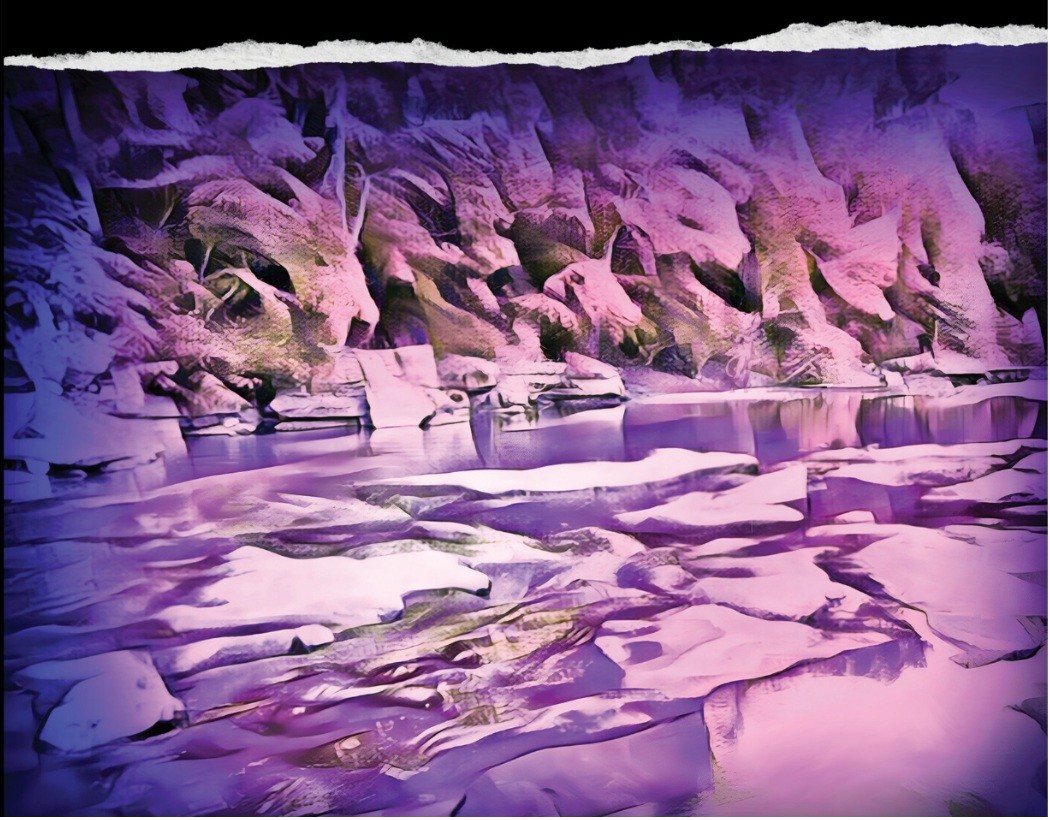
The last image associated with Chapter 25 is one of the strangest visual elements in the book. It is heavily purple, visually distorted, and presented immediately after Jon describes the failure of almost all of the photographs from the adventure.
Hunters have spent considerable time studying the image and have reported seeing possible figures scattered throughout it—including creatures, animals, human-like forms, and Pokémon-like shapes. Those reports are interesting, but they should be separated from what can actually be demonstrated.
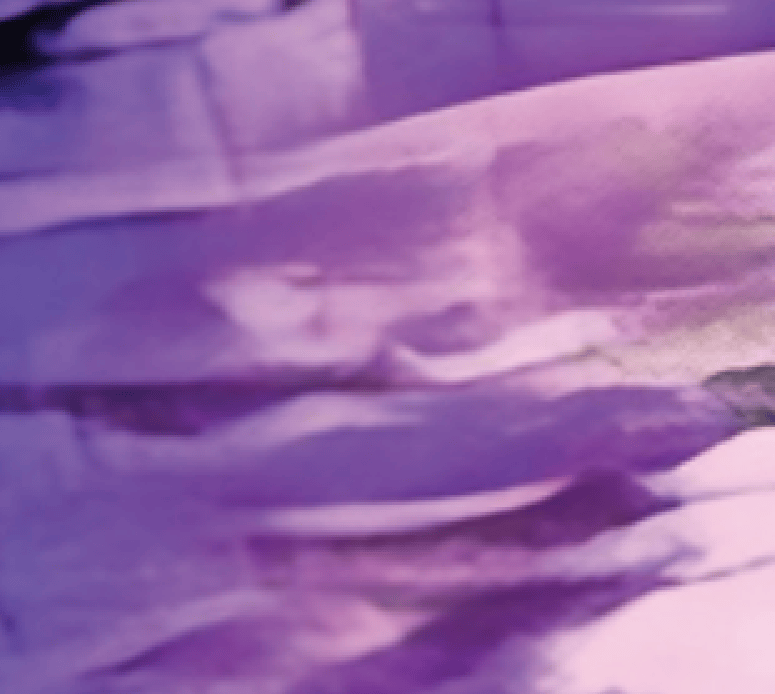
One especially useful example is the shark-like shape highlighted in an animated GIF. Even hunters who are skeptical of hidden figures often find that example difficult to unsee once it is pointed out.
Analysis
A photograph that invites interpretation
The image is unusual enough that close inspection is almost inevitable. Its heavy tint, blown highlights, irregular forms, and layered textures create many places where the eye can begin to organize ambiguous shapes into recognizable figures.
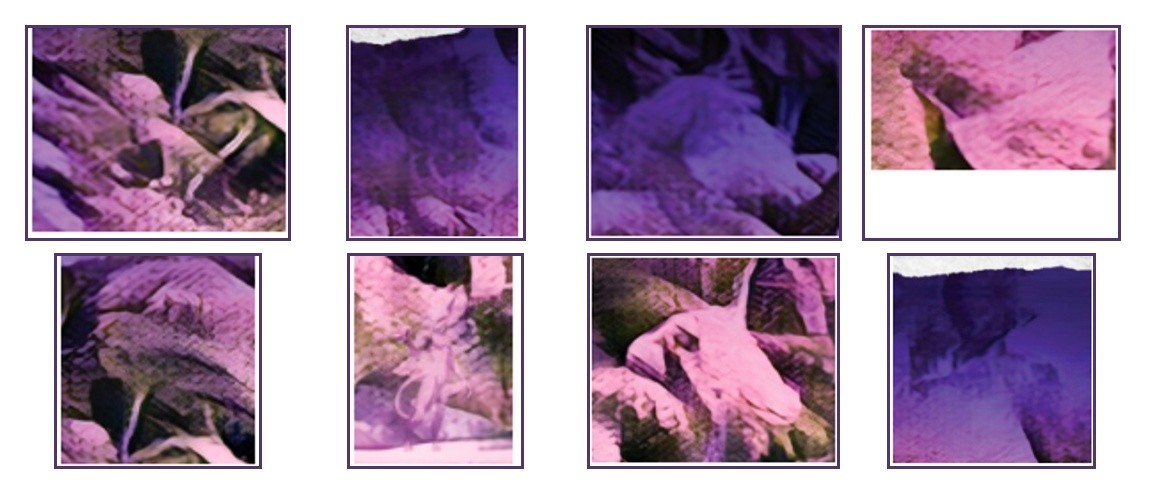
Some hunters say they can identify creatures, animals, men, and other figures scattered throughout the scene. Others see nothing intentional at all. The close-up crops collected from the image are useful because they show exactly which areas have drawn attention without requiring the article to tell the reader what each shape is supposed to be.
Close-up areas from the image that have drawn attention from hunters. No identification is asserted.
A word of caution about pareidolia
The human brain is extremely good at finding familiar shapes in ambiguous visual information. That phenomenon, known as pareidolia, can make faces, animals, characters, and other objects appear meaningful even when no deliberate image is present.
That does not mean every reported figure in the photograph is imaginary. It means the burden of proof should be higher than simply being able to see something after it has been suggested. A convincing hidden figure should remain recognizable under reasonable image adjustments and, ideally, be noticed independently by multiple viewers.
The shark example
The animated shark example. Whether intentional or pareidolia remains open.
The shark-like form is one of the clearest examples discussed by hunters. An animated GIF makes the shape easier to recognize by isolating and emphasizing the relevant area of the photograph.
Whether that form was intentionally embedded or is simply a strong case of pareidolia is still open. The value of the shark example is that it demonstrates why the image has generated so much debate: some shapes become surprisingly persuasive once attention is directed to them.
Could the image contain Pokémon-like figures?
Some hunters have proposed Pokémon-like forms within the photograph, including a possible Mewtwo-like figure. These identifications remain subjective and should not be treated as established hidden images.
The more defensible observation is simply that the photograph contains numerous ambiguous forms that invite repeated visual interpretation—and that this occurs in a chapter centered on Pokémon, augmented reality, unreliable photographic evidence, and altered perception.
An unusual choice of words
The ending introduces another puzzle. Jon does not explicitly say that the surviving photograph is shown below, on the next page, or at the end of the chapter. Instead, he says he felt he should share it “in this book.”
The natural reading is that the unusual purple photograph is the image he means. That is almost certainly how most readers will understand the sequence.
But in a puzzle book, the broader wording is worth noticing. “In this book” could simply be conversational phrasing—or it could leave open the possibility that the photograph being described is not necessarily the image immediately associated with the end of Chapter 25.
If that ambiguity is intentional, a provocative alternative question emerges: could the surviving photograph actually be another image elsewhere in the book? There is not enough evidence to claim that, but the wording is unusual enough to document rather than ignore.
Deep Dive
How to test the image more carefully
A disciplined visual test would preserve the original image and compare controlled versions using adjustments such as exposure, contrast, saturation, channel separation, and reduced purple tint. Potential figures should be evaluated in the same location across each version rather than searched for anew after every edit.
Blind viewing would be even more useful. Show cropped areas to people who have not been told what hunters claim to see and record what they identify first. If the same figure is repeatedly recognized without prompting, that is more persuasive than a shape that appears only after suggestion.
The bigger clue may be the uncertainty itself
The image does not have to contain ten deliberate hidden creatures to matter. Its ambiguity may itself fit Chapter 25’s broader pattern: reality becomes uncertain, photographs fail, terminology shifts, and the only surviving visual evidence is difficult to interpret.
That makes the final photograph potentially important even if every proposed creature eventually turns out to be pareidolia.
Bottom Line
What we know: The final purple image is heavily altered, visually ambiguous, and emphasized by the chapter’s ending.
What hunters report: Some see creatures, animals, men, Pokémon-like forms, and other figures scattered throughout the image. The shark-like example is among the most persuasive visual demonstrations.
What remains uncertain: None of those identifications is proven to be intentionally embedded.
What may be just as important: Jon’s choice to say the surviving picture is shared “in this book,” rather than explicitly identifying the adjacent image, leaves a small but intriguing ambiguity worth testing.
Sources & References
Primary source: Jon Collins-Black, There’s Treasure Inside, Chapter 25, including the final photograph and closing text.
Visual examples: hunter-supplied close-up crops from the final purple image and the animated shark GIF.
Keep investigating
Open Question
Is the real puzzle hidden inside the purple photograph itself—or in the possibility that the wording points us toward a different photograph somewhere else in the book?
Approved research contributions appear here after review.
Test Hunter
This is a test of the new community contribution system.
Anonymous
I think the article may be overlooking another interpretation of the final photograph. The wording at the end of the chapter may not necessarily identify the purple image as the surviving photograph.
Contribute to this Research
Share your strongest relevant evidence, correction, interpretation, challenge, connection, context, research lead, question, or editorial suggestion. This is for substantive research contributions rather than general conversation.
Email privacy: Your email address is private. It is not displayed publicly, used for marketing, sold, or shared at any time with anyone outside StaceyToon.com. It is used only for verification, contribution-limit/moderation controls, and necessary contribution-status communication.
Community research
Community Contributions (2)
Approved research contributions appear here after review.