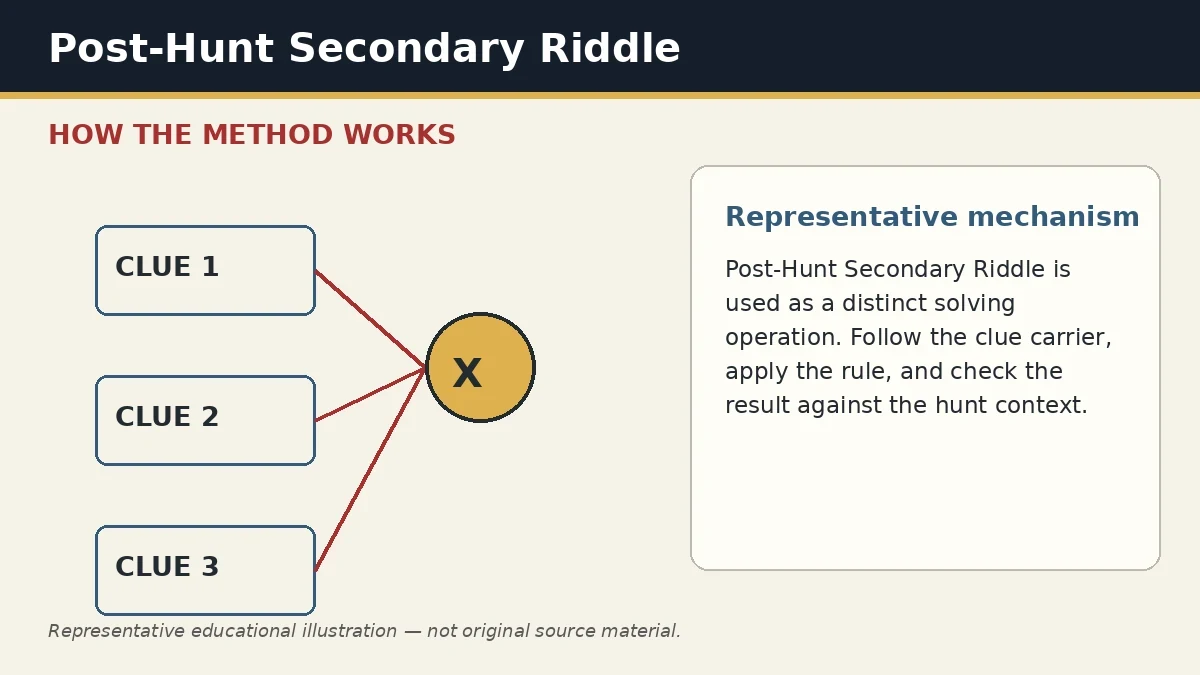
Representative illustration of Post-Hunt Secondary Riddle; created for teaching and not reproduced from Breakfast Tea & Bourbon.
Analysis
The simple idea
After the main treasure was found, a new riddle challenged solvers to identify a tiny area and offered another prize.
Plain-English version: You are looking for a repeatable rule that turns something odd or deliberate in the clue into useful information. The formal name for this particular technique is Post-Hunt Secondary Riddle.
What to look for
Look for a rule connecting several clues that do not make complete sense on their own.
What you'll need
Notes showing each intermediate answer and the order in which the hunt presents them.
Walkthrough: how to think through it
Step 1: Solve the smaller pieces first.
Step 2: List the outputs without forcing a conclusion.
Step 3: Look for the shared rule or theme connecting them.
Step 4: Apply that rule and verify the combined result against the hunt's remaining clues.
Representative illustration of Post-Hunt Secondary Riddle; created for teaching and not reproduced from Breakfast Tea & Bourbon.
How Breakfast Tea & Bourbon used it
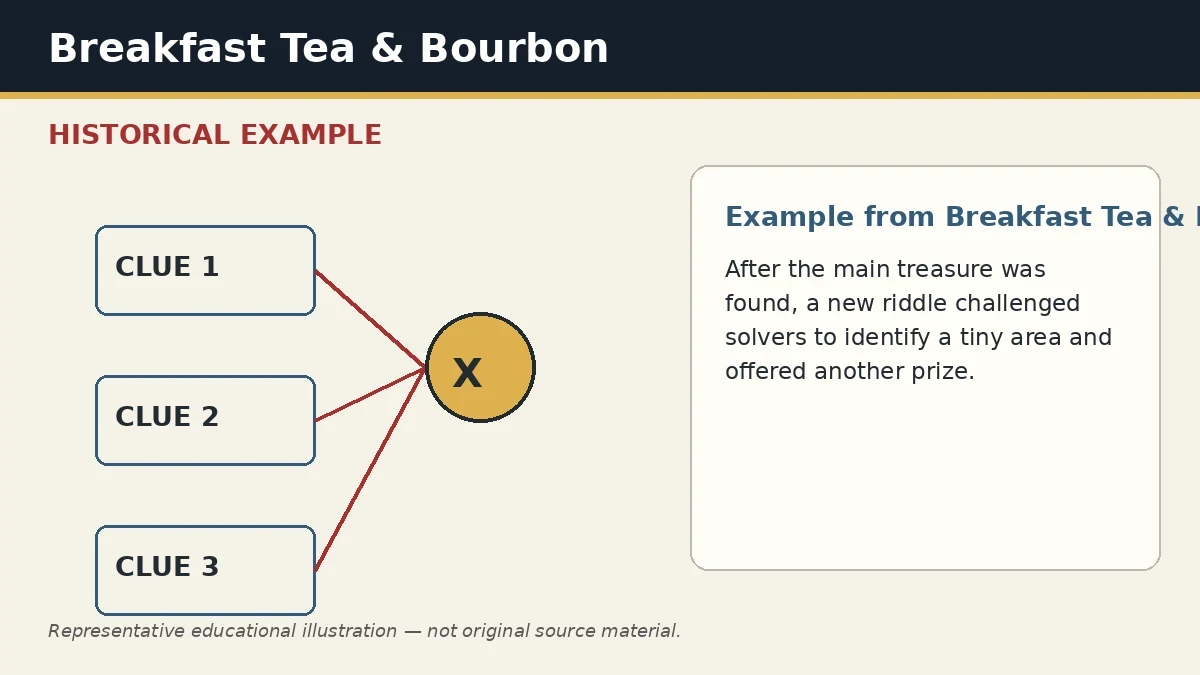
After the main treasure was found, a new riddle challenged solvers to identify a tiny area and offered another prize.
That is the important part of the historical example: the solver was not merely told to use Post-Hunt Secondary Riddle. The hunt presented information in a form that made this operation useful. The lesson for a modern hunter is to recognize the signal first, then apply the method consistently.
Representative example illustrating how Post-Hunt Secondary Riddle was used in Breakfast Tea & Bourbon; not original source artwork.
What it produced
In this example, the method converts the clue material into a more useful output—such as a letter, word, number, direction, location, relationship, or confirmation. The exact output matters less than the reusable lesson: recognize the signal, apply one consistent rule, and confirm the result elsewhere.
Hunter takeaway
Keep sequels and post-hunt puzzles separate in a methodology database even when they share a title/brand.
How certain is this example?
Evidence level: creator-documented. The article keeps documented solution mechanics separate from interpretation where the historical record is incomplete.
Deep Dive
Why this belongs in your toolbox: Post-Hunt Secondary Riddle is best treated as a technique to test when the clue gives you the right signals—not as a universal answer to every puzzle. Once you understand the simple operation above, the historical example from Breakfast Tea & Bourbon shows how a puzzle designer can disguise that operation inside a larger hunt.
Bottom Line
Remember this: Keep sequels and post-hunt puzzles separate in a methodology database even when they share a title/brand.
Sources & References
Ready to see the real hunt? Explore the Original Research & Solution Sources
Next step: The lesson above is intentionally simplified. Use these links to examine the historical solution material, original-context discussion, and available source imagery for yourself.
The examples above are teaching summaries. Use the references below to see the documented historical material, fuller solution context, and—where available—source images that tie the method back to Breakfast Tea & Bourbon.
Approved research contributions appear here after review.
No approved community contributions yet.
Contribute to this Research
Share your strongest relevant evidence, correction, interpretation, challenge, connection, context, research lead, question, or editorial suggestion. This is for substantive research contributions rather than general conversation.
Email privacy: Your email address is private. It is not displayed publicly, used for marketing, sold, or shared at any time with anyone outside StaceyToon.com. It is used only for verification, contribution-limit/moderation controls, and necessary contribution-status communication.
Community research
Community Contributions
Approved research contributions appear here after review.