Chapter 1 of There’s Treasure Inside tells two stories at once: the rise of Michael “Scotty” Scott as Apple’s first CEO and Scott’s later fascination with minerals and gemstones, culminating in the chapter’s extraordinary 120-carat sapphire crystal.
Much of the history checks out. Some of it checks out almost too well. But several statements become more complicated when examined closely. The strongest example is the chapter’s reference to the “first 5 3/4-inch floppy disk”: Shugart Associates introduced the 5¼-inch format in 1976, while 5¾ inches was approximately the width of the drive itself. That makes the wording more intriguing than a simple typo.
Rather than treating every compressed statement as a clue, this article separates verified fact, questionable or underspecified wording, and genuine discrepancy. The useful question is not merely “What is wrong?” but “Why was the story told this particular way?”
Analysis
1. Employee #007 — true, but not chronological
Chapter 1 recounts the famous early-Apple badge story: Woz received 1, Jobs ultimately claimed 0, and Michael Scott chose 007. The core anecdote is real. Scott later explained that Apple’s bank required employee numbers for payroll and that he chose seven because he wanted the James Bond joke. But Scott also said he was chronologically about Apple’s fifth employee. The numbers therefore were not a simple hiring sequence.
For ordinary Apple history, this is a funny anecdote. In a treasure-hunt book, it is worth remembering that the conspicuous sequence 0, 1 and 007 comes from a numbering system that was deliberately manipulated by the people involved.
2. “Doubled every three months for four years”
The chapter says Apple’s “size doubled every three months” for the next four years. Taken literally, four years contains sixteen three-month periods, and sixteen doublings produce a multiplier of 65,536. Apple unquestionably grew explosively, but “size” is undefined: employees, sales, revenue, production, valuation, or some broader measure?
This is best classified as an ambiguous quantitative claim, not a clean factual error. It nevertheless hands the reader an unusually neat cluster: four years, three months, doubling.
Several Apple II design anecdotes sound exaggerated but are rooted in early Apple history.
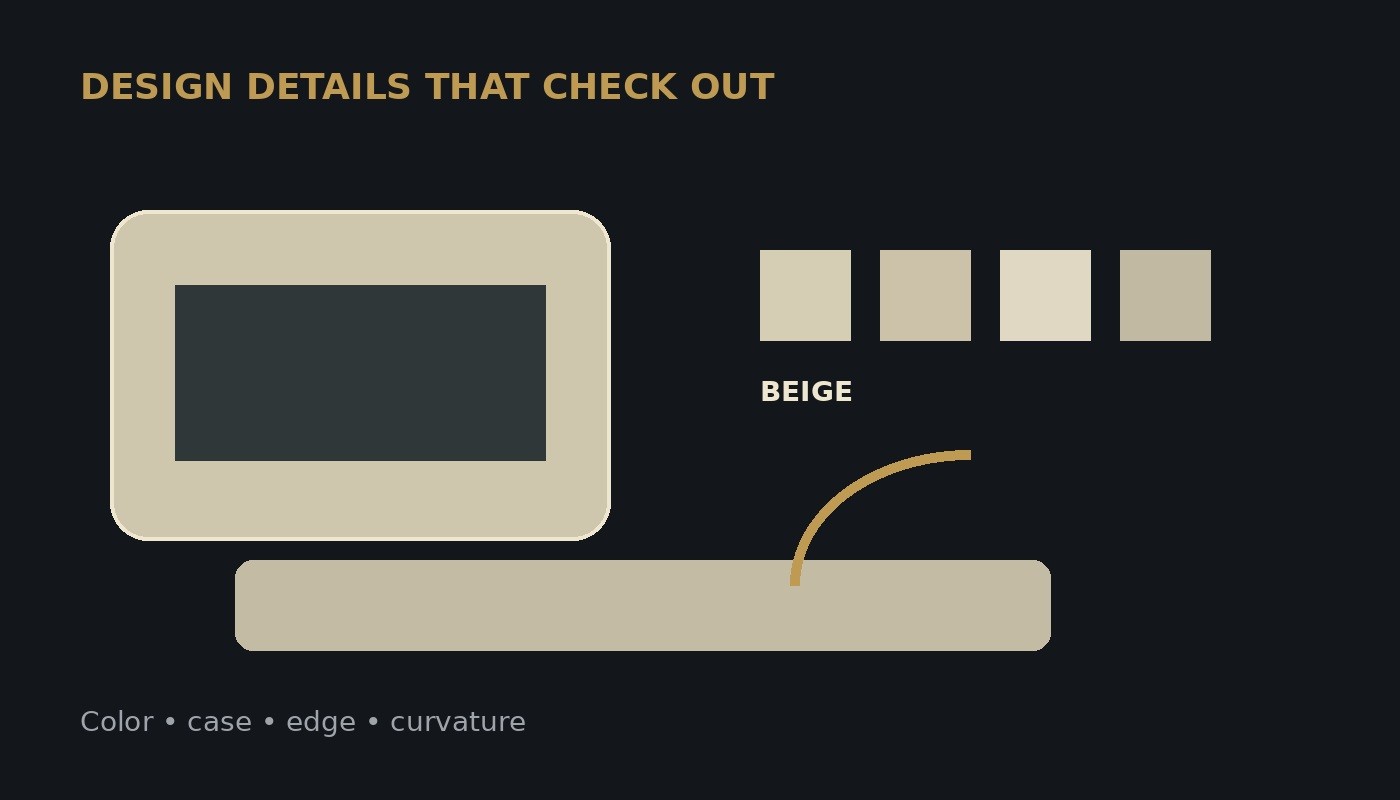
3. Apple beige and rounded corners mostly check out
The chapter’s account of Jobs obsessing over the Apple II’s beige color and rounded case initially sounds exaggerated. Michael Scott’s own recollections support the substance of it: Jobs rejected standard beige choices and spent weeks debating the case’s curvature. Other historical retellings differ on whether Apple actually created a new registered beige or Scott stopped Jobs before doing so, so the safest conclusion is that the design obsession is well supported while the exact “Apple beige” outcome is source-dependent.
The narrative effect is still notable. Before Chapter 1 reaches a naturally formed crystal, it has already trained the reader to notice color, case, edge, roundness and deliberate form.
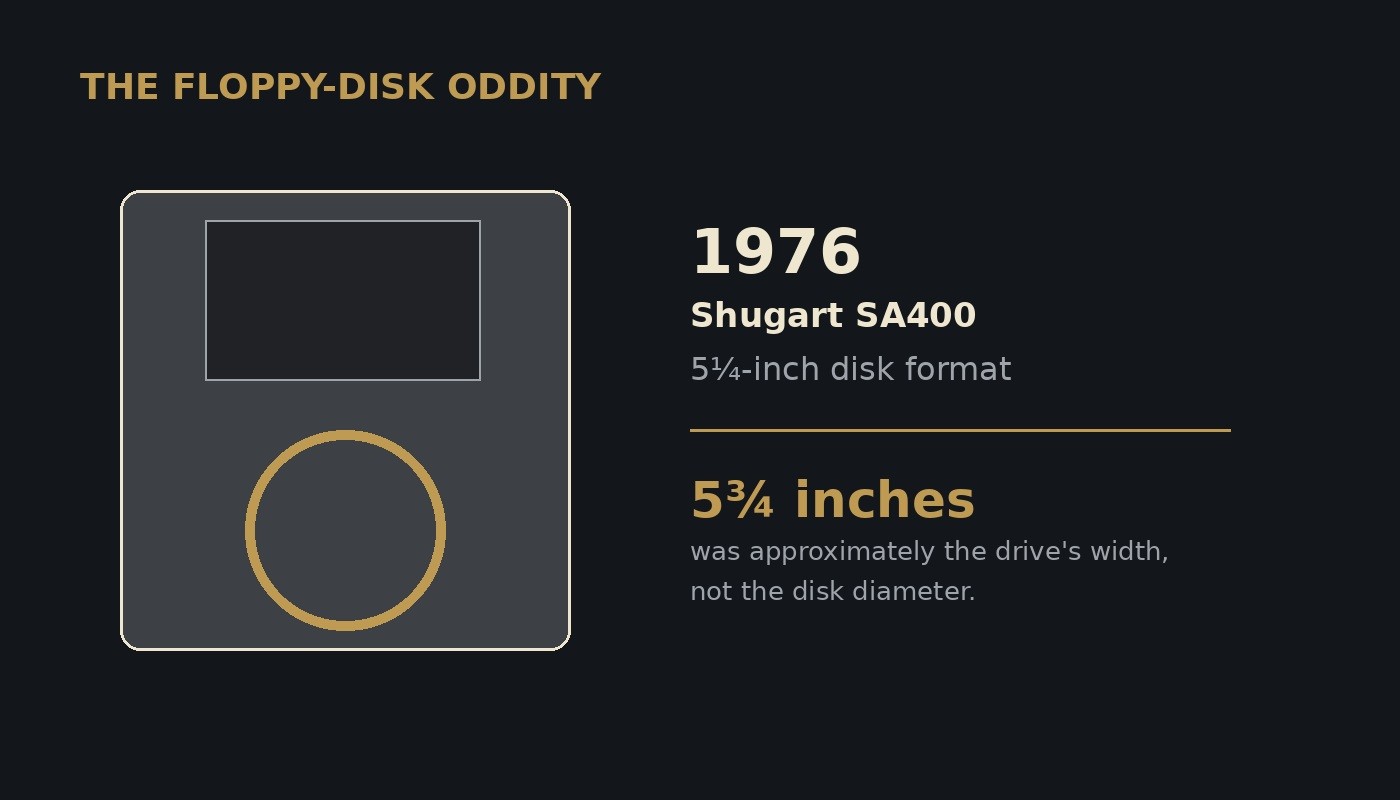
The chapter’s 5¾-inch wording may conflate the disk diameter with the drive’s physical width.
4. The floppy-disk statement is the strongest anomaly
The book says Apple released the Apple II and Apple III “as well as the first 5 3/4-inch floppy disk.” This creates two separate problems. The disk format associated with this history is 5¼ inches, and Apple was not first: Shugart Associates announced its SA400 5¼-inch drive in 1976, before Scott became Apple CEO.
But the apparent 5¾-inch mistake has an unexpected wrinkle. Historical specifications for the SA400 put the drive itself at roughly 5.75 inches wide. In other words, the chapter’s 5¾ measurement resembles the drive’s physical width while the disk inside it was 5¼ inches.
That does not prove deliberate construction. It does mean the anomaly is richer than “wrong fraction.” The sentence combines a questionable first with a measurement that belongs to a related object.
5. “Third largest” is too precise without a definition
The chapter says the Apple II sold more than six million units and Apple became the “third largest manufacturer of home computers.” The six-million figure is broadly consistent with historical estimates for the Apple II family. The ranking is harder to pin down because early computer-market standings vary by year, geography, revenue versus units, and whether the category is “home,” “personal,” or microcomputers.
Without those qualifiers, third largest is best treated as underspecified rather than demonstrably false.
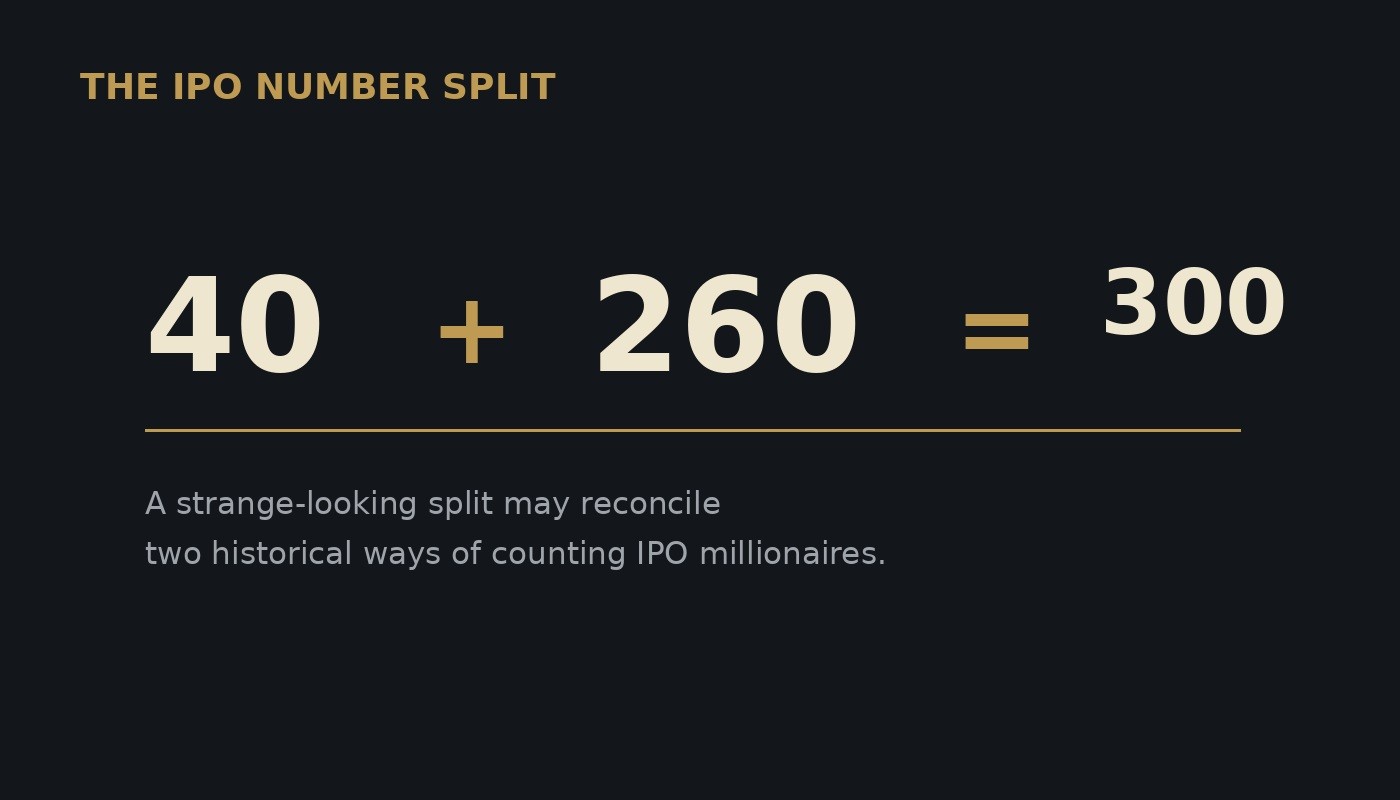
The chapter’s unusual 40 + 260 split may reconcile two historical ways of describing Apple IPO millionaires.
6. The IPO numbers may be more careful than they look
Chapter 1 says Apple’s 1980 IPO created 40 millionaires that day and another 260 shortly after. Historical accounts often circulate two different figures: more than forty employee/insider millionaires and roughly three hundred millionaires in a broader accounting. The chapter’s unusual split gives us 40 + 260 = 300.
That may simply reconcile different source populations, but it is an important control against assuming carelessness. A writer could have said “hundreds” or “about 300.” Instead, the chapter preserves two component numbers.
7. The $1.7 billion first-day valuation is reasonable
Apple went public on December 12, 1980. The chapter’s statement that the company was worth more than $1.7 billion at the end of the first trading day is consistent with widely reported historical figures. This is another reminder that unusually specific numbers in the chapter are not automatically errors.
8. Scott’s mineral career is not embellishment
After Apple, Scott became a serious mineral and gemstone collector and supporter of mineralogical research. His collection was significant enough to form the basis of the Bowers Museum exhibition GEMS! Colors of Light and Stone. The chapter’s abrupt transition from computing executive to mineral collector therefore reflects a genuinely unusual life story rather than invented connective tissue.
9. Scottyite is real
The improbable-sounding mineral scottyite is a formally recognized mineral species named in honor of Michael Scott. That makes it one of the chapter’s best examples of a detail that sounds like puzzle-book wordplay but survives factual checking.
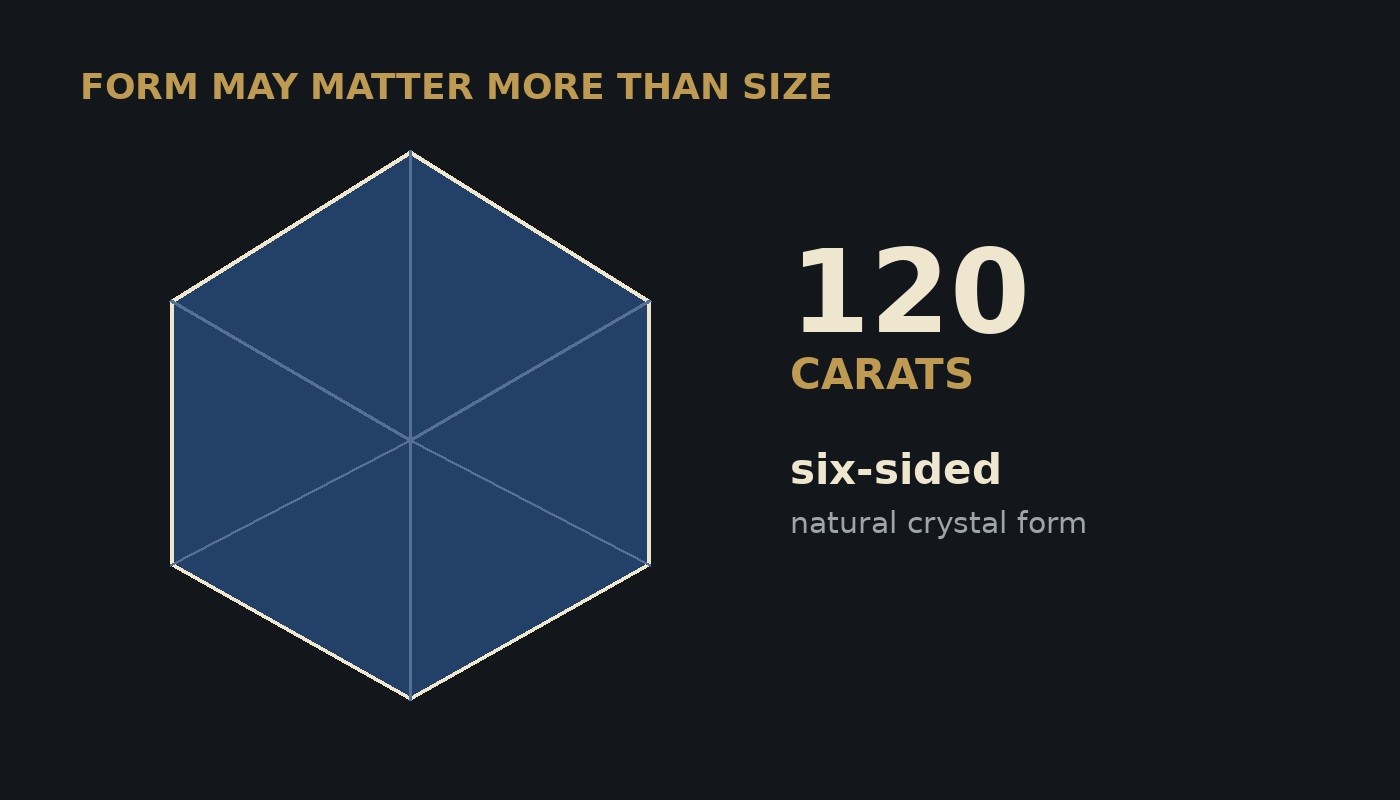
The sapphire’s preserved natural crystal form may be more significant than weight alone.
10. The six-sided sapphire is geologically plausible; the rarity count is harder
Sapphire is gem-quality corundum. Corundum belongs to the trigonal crystal system and commonly presents rough barrel-shaped or hexagonal-prismatic habits, so a naturally six-sided-looking sapphire crystal is not inherently suspicious. The chapter’s emphasis on a large crystal retaining its natural form is therefore plausible.
The more difficult claim is the suggestion that fewer than a dozen comparable 120-carat crystals exist. There is no obvious worldwide registry of every privately held natural sapphire crystal, and “comparable” can involve weight, completeness, color, habit, provenance and quality. The estimate may be correct, but it is much harder to independently prove than the underlying mineralogy.
Deep Dive
Error, compression—or construction?
If Chapter 1 were sloppy from beginning to end, the safest lesson would be not to overthink its mistakes. That is not what the fact-check produces. The employee-number story survives. The Apple II design obsession survives. The IPO valuation survives. Scott’s mineral collection survives. Scottyite survives. The museum exhibition survives. Natural six-sided-looking corundum crystals survive.
That makes the places where the wording does not fit cleanly more conspicuous: size doubled every three months, third largest, the unusual 40 + 260 construction, and especially first 5 3/4-inch floppy disk.
The floppy line is now particularly interesting because 5¾ inches is not random noise: it approximates the width of the early Shugart drive while 5¼ inches is the disk format. That is still fully compatible with an ordinary research/editing mix-up. But for a treasure-hunt researcher, it is exactly the sort of anomaly worth recording rather than “correcting” and forgetting.
The larger pattern is numerical: 0, 1, 007, three months, four years, six weeks, first, 5¼/5¾, third, 40, 260, 300, 2,600, six sides, 120 carats, and fewer than twelve. That does not establish a cipher. It establishes that Chapter 1 is unusually hospitable to counting, ranking, measuring and comparing.
Bottom Line
What we know: Most of Chapter 1’s obscure biographical and mineralogical details are defensible. The strongest historical problem is the floppy-disk sentence: the 5¼-inch format predates Apple’s Disk II, and the printed 5¾-inch measurement appears to describe the approximate width of a drive rather than the disk.
What we think: The mixture of accurate obscure facts, ambiguous quantitative wording and oddly preserved numbers is more interesting than a simple list of errors.
What we do not know: None of these anomalies by itself proves intentional clue construction. Their value is as documented signals that can be tested against patterns elsewhere in the book.
Sources & References
Engadget — Michael Scott interview summary covering employee #007 and Apple II case debates.
There’s Treasure Inside, Chapter 1, especially pp. 22–23 — primary source for the claims examined here.
Keep investigating
Open Question
If the questionable details are intentional, what should hunters do with the numbers that appear specifically inside those questionable or unusually constructed statements? The 5¼ / 5¾ discrepancy may be the best place to start.
Approved research contributions appear here after review.
No approved community contributions yet.
Contribute to this Research
Share your strongest relevant evidence, correction, interpretation, challenge, connection, context, research lead, question, or editorial suggestion. This is for substantive research contributions rather than general conversation.
Email privacy: Your email address is private. It is not displayed publicly, used for marketing, sold, or shared at any time with anyone outside StaceyToon.com. It is used only for verification, contribution-limit/moderation controls, and necessary contribution-status communication.
Community research
Community Contributions
Approved research contributions appear here after review.